

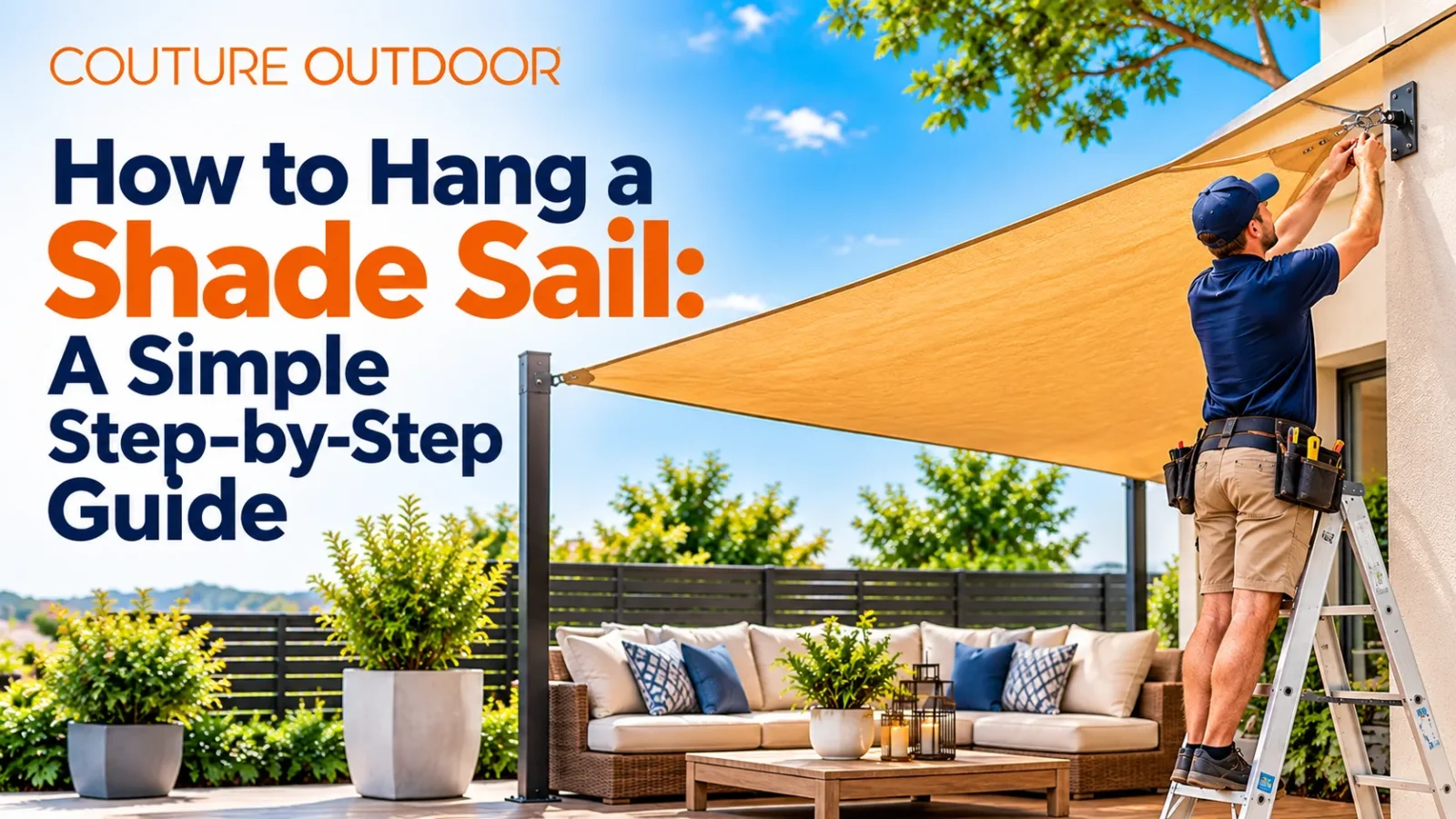
Adding a Shade Sail to your patio, garden or poolside area gives you added comfort by providing shade while using minimal space. Installing a Shade Sail requires planning to find the right anchor points, hardware and the space to pull the fabric as tight as possible. Loose fabric and supports that give way over time are some common problems when a Shade Sail is installed incorrectly. This article will describe how to hang a shade sail properly.
1. Choose the Right Location
Identify the areas in your location that require the most shade. It could be your patio dining area, garden seating area or poolside lounge. Make sure the area you select does not block any doors, windows, walkways, or obstruct any furnishings.
2. Choose the Right Shape and Size
Shade sails are available in a variety of shapes and sizes (rectangular and square sails, triangle sails and custom shapes). When deciding how to hang a Shade Sail, make sure the support points are beyond the corners of the sail.
3. Check the Fixing Points
Depending on your situation, the following can be used as your anchor points:
- Strong Walls
- Support Beams
- Support Posts
The product instructions allow for use on healthy trees. Do not use the product to attach sails to gutters, weak fences, or thin metal sheets. Large sails or new support structures require the consultation of a qualified installer.
4. Measure the Area and Plan the Height
Measuring the distance between the mounting points and comparing it to the sail size and hardware restrictions will help in the planning of the assembly. Many installations incorporate varying heights at the corners to allow water to run off. Some products, however, require little to no slope for water to drain. When planning for the assembly of a shade sail, be sure to check for clearance for people walking by and to ensure the lowest edge of the sail does not create an obstruction for people.
5. Prepare the Support Posts
If adequate walls and beams do not exist, then support posts are necessary. The size, materials, and foundations of the support posts are dependent upon the conditions of the site, the sail, and the manufacturer’s instructions. Make sure the foundations are fully set and the sail can be securely attached to the support posts.
6. Get the Right Fixing Hardware
In order for a sail to be secured, proper hardware must be used to connect the sail to the support points. Some of the fittings that may be used for the assembly of a sail are:
- Eyebolts and fixing plates for attachment to walls and posts
- Turnbuckles for adjustment of tension
- Carabiners and shackles for connection of corners to fittings
- Corner rings for attachment of corners of sail.
The right sail hardware is specific to your sail. Use fittings and hardware rated for the outdoors. Avoid using hooks and light-duty fittings.
7. Attach the Sail
Lay the sail out and identify which corners are connected to each fixing point. Attach all corners with the correct connectors. At this point, do not fully tighten any connections. Make sure the sailcloth is in the appropriate position and all corners are lined up.
8. Tighten the Sail Evenly
Tension the sail evenly. If turnbuckles are used, adjust slightly and repeat for all. The sail should have a smooth, even fit with no large folds or wrinkles. Do not over-tension, as this will put unnecessary stress on the fabric, fittings and support points. If a post moves or a fitting bends, stop and get a professional to help with the installation.
9. Check the Installation
Inspect every corner connection. Check all posts and wall anchors. Make sure there is no movement in the support structure. Check the shape of the sail and see if it is as planned. Review the manufacturer’s instructions about wind loads. A Shade Sail should not be treated as a storm cover or a waterproof roof. Knowing how to hang a shade sail means knowing you need to inspect it periodically.
10. Keep Your Shade Sail Clean
Leaves, dust and other debris can accumulate on your shade sail and should be removed regularly. Clean the sail according to manufacturer recommendations to avoid damaging the fabric. Check the stitching and corner reinforcements to see if they are beginning to fray. Fraying is an indication of potential failure. Before storing the sail for the winter, it should be cleaned and allowed to dry completely.
Can You Hang a Shade Sail from a Wall, Tree, or Pergola?
A wall, tree, or pergola can serve as a support structure, as long as it is strong enough to support the sail. Some shade sail kits are designed to be attached to walls or trees, while others require support posts. The Modern Sail Shade by Couture Outdoors can be wall or tree-mounted, as well as pole-mounted, to provide three or four support points, depending on the configuration. A pergola may also work as a support point, as long as the frame can support the sail. Always check the structure before mounting the sail.
What If You Want an Adjustable Shade Sail?
A typical shade sail is fixed in a single position. For more flexibility, an adjustable system can be used to control the covering more. An example of a smartphone remote sail shade can be found at Couture Outdoors. The Adonis Convertible Sailshade Pergola by Couture Outdoors also has a manual crank system to adjust the covering. A convertible sail shade provides the user the ability to adjust how much cover is provided by the sail, as opposed to a fixed shade sail. The type of system used determines how the sail is mounted.
Common Mistakes to Avoid
There are three main mistakes typically made by DIYers. Attaching the sail to support structures that aren’t strong enough to support the load. Only measuring the fabric and neglecting to take the hardware into account when determining the sail size. Not ensuring the sail has a proper downward slope.
- Tightening only one corner.
- Neglecting wind and rain conditions.
- Skipping routine checks.
All of these issues can be prevented with proper planning of the installation of a shade sail.
When Should You Get Professional Help?
A professional can be of great help when dealing with large sail installations or support posts, or when a sail is mounted to a building. A professional can verify the support points, measurements, hardware, and the foundation. If you’re considering a large luxury outdoor sail shade, discuss your design and installation before purchasing. This can help you validate that your space can accommodate the sail.
Explore Shade Sail Options at Couture Outdoor
Couture Outdoor has triangle, square and rectangular shade sails. The collection also includes adjustable and smartphone-controlled sails for residential, commercial and hospitality use. Determine what kind of cover you need and how you’ll utilize the space before deciding how to hang a shade sail.
Frequently Asked Questions
How many fixing points do I need for a shade sail?
Triangular shade sails require 3 fixing points. Squares and rectangular sails require 4. For the precise requirements, refer to the instructions provided with your product.
Can I attach the shade sail to my house wall?
Yes, but the wall and the fixing method must be able to take the load. The wall should be checked before installation.
Can I hang the shade sail from a tree?
Depending on design, tree mounting may be possible. The tree must be strong and healthy and the fixing method must be in accordance with the manufacturer’s instructions.
Does the sail need to be tight?
Yes, but avoid over-tightening as it can cause the sail to become misshapen.
Can I leave the sail out during strong winds?
It depends on the product. Follow the manufacturer’s instructions on strong winds and remove the sail if required.