

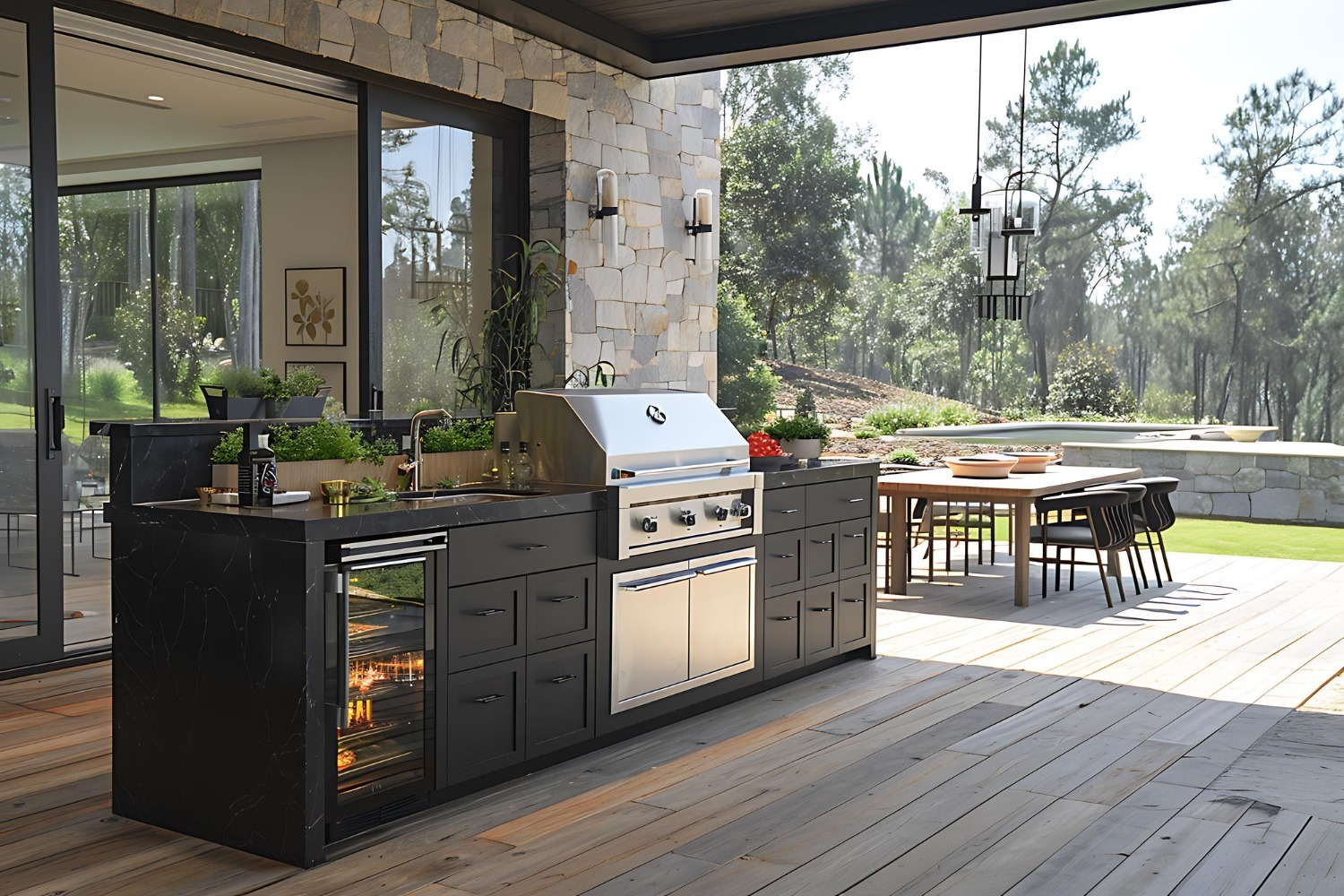
Ask ten people about the best outdoor kitchen cabinet. You will get ten different answers. Because the choice of a modern outdoor kitchen depends on where you live and how much space you have. Something that does fine on a covered patio might struggle on a rooftop or right by the sea. Below we go through the types of cabinets, what they are made of, and a few checks to do before you spend any money. It applies to a backyard at home, and to hotels, resorts and restaurants as well.
What Outdoor Kitchen Cabinets Do
The body of your outdoor kitchen is called cabinets. The grill sits in them. Your tools and plates go inside. And the top gives you space to chop and put things down. You usually end up with a few units in a row. The grill goes in one, a couple holds your stuff, and a sink or small fridge might take another. The weather is hard custom pergolaon all of it. Rain, sun, heat, cold nights. This is why indoor cabinets are the wrong pick here. So always choose units that are built for outdoor use.
Types of Outdoor Kitchen Cabinets
Base cabinets
These sit on the floor and come with drawers or both. Pots, tools, charcoal and dry food all go in here.
Grill cabinets
These are made for a built-in grill dining table to sit in. The opening must fit your grill exactly, so get the grill’s size before anything else.
Corner units
Corner units are for kitchens that bend around a corner. Without one you waste that space.
Sink and prep cabinets
Take a basin and a tap. Water and drain lines have to reach them. Here, it is important to think about plumbing at the start.
Island and bar units
These give you a counter with seats. Guests sit, the cook cooks. They fit bigger spaces best, like a hotel terrace or restaurant patio.
Modular systems
Modular systems are separate units you mix and match. You can build the outdoor kitchen in stages, and moving things around later is not hard.
Materials to Look At
This is where most of your time should go. These are the usual options.
Stainless Steels
Lots of people like stainless steel because you just wipe it down. Grade matters though. 304 is what you see most in outdoor kitchens. By the coast, many go for 316, because salt in the air can stain lower grades. Ask which grade is in the cabinet you are looking at.
Powder-coated aluminium
Aluminum does not rust, and is lighter than steel. To check this, see how the coating holds up. Ask how the coating stands up to UV rays from the sun and to rain after a few years.
Marine-grade polymer
It is a tough plastic board built for wet areas. Moisture won’t make it rot, so it does well in damp corners and by the pool.
Teak and other hardwoods
Teak looks warm and handles weather well. To keep the colour you need to look after them a bit. They go nicely beside stainless steel when you want a softer feel.
Concrete and stone
Concrete and stone, or anything with a stucco finish, is built in and very strong. The catch is it stays where it is. If you want to change things later, it costs more.
Watch out for the words weatherproof and rustproof on a label. Hardly any material is both. Better to ask the maker what the cabinet can really take, and what upkeep it needs.
Countertops
The top sits in the sun and gets splashed all day, so it works hard. People use granite, porcelain, concrete or stainless steel outside. Pick one that is sold for outdoor use. Colour matters too. Light tops show every mark. Dark ones heat up when the sun is on them all afternoon.
Hinges, Drawers and Other Small Parts
The big panels get all the attention, but the first parts to rust are usually hinges and handles, particularly cheap ones. Ask what they are made from if the seller doesn’t say. Slides matter more than you would think. A drawer full of heavy tools, collecting dust all year, is hard on cheap ones. Soft-close slides cost extra, but they last longer.
Try the doors. They should close snugly, which matters if dry food is going in there. Outdoor kitchen cabinets with a propane tank inside, or a gas grill above, need ventilation. Go by the grill maker’s instructions. Adjustable feet are handy too, as a deck or patio is seldom perfectly level.
Layout
Plan around how you really cook. Start with the grill spot and keep the counter free on either side. One side takes the tray of food, the other is your prep area. The sink can sit nearby, but leave a gap so water doesn’t splash onto the burners. Leave room to walk around as well. A counter that runs into a chair is a nuisance whenever someone sits there. Want guests nearby while you cook? A built-in grill dining table or a bar-height island lets you chat with them across the counter.
Home and Commercial Kitchens
At home you might cook a few evenings a week. A hotel or restaurant kitchen is a different animal. It works from morning till night, rain or shine, and plenty of people use it. So choose tougher hinges and deeper drawers. Smooth surfaces help too, since staff have to wipe them down between services. Local rules for gas and food areas matter, so check them.
In a business, think about how staff walk through. They shouldn’t have to cross the guest area to get to the kitchen. The kitchen should also look like part of the same space as the seating, so plan it along with your designer contract commercial hotel outdoor furniture.
Rooftops bring weight and wind into it. Ask how much the floor can carry and how the units get fixed down. Anything you put up there, rooftop outdoor furniture included, needs to be fastened well.
Cover and Shade
A cabinet lasts longer when rain isn’t landing on it all the time, so some cover is worth having. A custom pergola over the cooking area is one way, and the cook gets some shade too. Before you build, read the grill maker’s rules and leave enough height above the cooking surface.
Mistakes people make
The most common one is buying kitchen cabinets before the grill. The next is choosing on looks alone and never asking what the unit is made from. People also forget that a sink or fridge needs water or power, and that these have to be planned before anything is fixed in place. And a surprising number of kitchens end up with no counter space beside the grill at all.
Quick Checklist Before You Buy
- What is the cabinet made from, and what grade or finish is it?
- Is it made for outdoor use?
- Does the cut-out fit your grill or sink?
- Are the hinges, handles and slides made from rust-resistant parts?
- Do you need venting or a seal?
- Is the countertop suitable for outdoor use?
- How should you clean and look after it?
- Does the unit suit home use or commercial use?
Conclusion
Begin with the space, then the grill, then the cabinets. Allow time to spend with the material and the measurements. If you are in the process of designing a home, hotel or restaurant kitchen, take a look at the ranges on the Couture Outdoor website or reach out to the team for a design consultation.
FAQs About Outdoor Kitchen Cabinets
What is outdoor kitchen cabinet material?
Most outdoor kitchen cabinets are made of either stainless steel or an aluminum alloy that is powder-coated. Marine-grade polymer is also popular. If you live in an ocean-side environment, go with 316 stainless steel, which is specifically designed to withstand corrosion caused by salt.
Can I use indoor cabinets outdoors?
Not a good idea. Outdoor environments (including the climate) really impact cabinets. They can rust, and warp.
How much space do I need around a grill?
The amount of space really depends on the grill, however, most manufacturers suggest 15-18″ of clearance around the grill, and leaving some counter space on either side. Keep in mind, if you are using a gas grill, you may need a permit.
Is it a good idea to do a modular setup?
It’s usually a good idea. With a modular system, you can always start small and add on later. Just make sure you select cabinets that are the same size and same height.